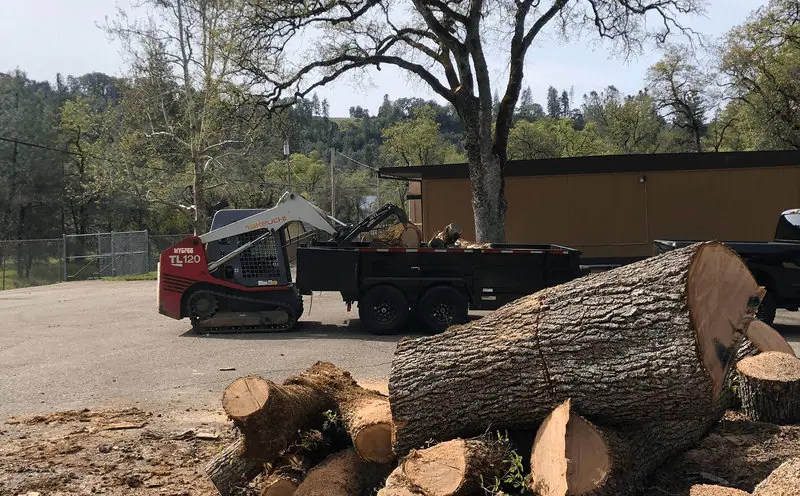
Storm season hit Granite Bay hard this year. We’ve taken calls from homeowners who woke up to a valley oak leaning 30 degrees toward their garage. Others had a branch the size of a telephone pole punching through a pergola. Wind gusts hit 50 mph. The ground was already soaked from three straight days of rain. Roots let go. Trees that looked fine last week don’t look fine now.
A tree down, leaning, or split after storm damage creates a safety issue that doesn’t wait. The tree’s under tension you can’t see. Branches are hung up in the canopy. Roots pulled halfway out of saturated soil. We’ve seen homeowners try to handle this themselves and end up with crushed fences or worse. Don’t be that person.
What this covers:
- Immediate safety checks after storm damage
- What professionals assess before cutting
- Why DIY storm tree removal fails (and costs more later)
- Insurance coverage realities for California homeowners
- Storm damage removal costs in Granite Bay
- Response timing that protects your property
Check for Immediate Hazards
Walk your property but stay back from damaged trees. Look for trees leaning toward structures, power lines, or vehicles. Check for large branches hung up in the canopy. We call those widowmakers. Look for exposed root balls or soil mounding on the opposite side. Check for split trunks with visible cracks running vertically. Look for trees resting on roofs, fences, or other trees.
Trees touching power lines are off-limits. Call 911 first, then PG&E at 1-800-743-5002. Then call Ace Tree Service. We won’t touch it before the utility clears the line. We’ve seen too many close calls with live wires
What Professionals Check First on Storm-Damaged Trees
Our crew walks up to every damaged tree looking for three things: stability, tension, and secondary hazards.
Stability means figuring out if the tree’s going to move again on its own. A tree leaning 45 degrees with half its roots exposed is still moving. Wind shifts. Soil settles. Someone walks too close and it goes the rest of the way down. We’ve seen a leaning oak in Folsom that looked stable drop another ten feet while the homeowner was inside calling for quotes.
Tension is harder to spot but it’ll hurt you faster. A tree splits or a big branch breaks halfway and stays hung up. You’ve got stored energy like a coiled spring. Cut the wrong spot and it releases. Our crew uses pole saws on anything under tension before we’re anywhere near it with a chainsaw. You can’t rush this part.
Secondary hazards are what’s near the tree. Other trees holding it up. Fences. Sheds. Propane tanks. Underground utilities. Anything that turns a tree removal into a two-problem job. We flag all of it before we start cutting.
Don't Try Storm Damage Removal Yourself
You’ve got a chainsaw. The branch doesn’t look that big. But storm-damaged trees don’t behave like healthy trees you’re trimming in July.
They’re under pressure. Cambium layers are torn. Weight distribution changed the second the tree split. You cut from the wrong side and the trunk rolls. The branch kicks back. The whole thing drops on your truck. We’ve seen all three happen to people who thought they knew what they were doing.
Homeowner injuries from storm cleanup happen every year. Chainsaws are dangerous enough without tension and unpredictable movement added in. Plus, cutting a tree that’s already on your roof and making it worse leads to insurance questions about improper mitigation. Why risk it.
Insurance Coverage for Storm Damage Tree Removal
Your homeowner’s insurance covers storm-damaged tree removal if the tree hits a covered structure. Roof, garage, fence (sometimes), shed (depends on your policy). They’ll pay to remove the portion of the tree that’s on the structure and enough access to make repairs.
What they don’t cover: a tree that fell in your yard and didn’t hit anything. A leaning tree that didn’t fall yet. Trees that came down on driveways, landscaping, or lawn areas. Some policies cover up to $500-$1,000 for debris removal if the tree damages covered property. Read your policy. Every carrier’s different.
A tree came from your neighbor’s yard and hit your house? Your insurance covers it, not theirs. Trees are considered acts of God in California. Proving neighbor negligence is harder than just filing with your own carrier and moving on.
Document everything. Photos from multiple angles. Wide shots showing the whole tree and property. Close-ups of damage. Email them to yourself with a timestamp. Your adjuster needs this and you don’t want to rely on memory two weeks later.
Storm Damage Tree Removal Costs
Costs depend on size, location, and how complicated the removal gets.
Trees on your roof, through a fence, or tangled in power lines increase costs. Crane-assisted removals in tight Granite Bay lots with limited access can hit $10,000 for huge trees. Every job’s different and we can’t quote it without seeing it.
We don’t charge extra just for storm damage. We charge for complexity and risk. A tree that fell clean in an open yard is straightforward. A tree that’s 60% standing and 40% down with half the weight on your neighbor’s shed takes time, equipment, and experience.
Timing Matters After a Storm
The longer a damaged tree sits, the worse it gets. Gravity doesn’t stop. Soil erodes. Wind keeps blowing. A tree that’s barely leaning Monday can be fully down by Friday.
An immediate hazard (on your house, blocking your driveway, threatening to fall on someone) gets same-day or next-day response when we can. During major storms across the Sacramento area, everyone’s calling at once. We triage based on safety risk. A tree on a roof beats a tree leaning in a back yard.
Not urgent but still damaged? Get it scheduled within a week or two. Waiting until spring doesn’t make sense. You’re rolling the dice on another storm finishing the job.
Trees That Didn't Fall but Look Bad
Your tree didn’t come down but you’re worried after the storm? Call for an assessment. We look for cracks in the trunk or major limbs. Exposed roots or soil heaving on one side. New lean that wasn’t there before the storm. Broken branches still attached in the canopy. Bark wounds or splits that compromised structural integrity.
Some trees bounce back. Some don’t. We’ve seen valley oaks lose 30% of their canopy in a windstorm and recover over two years. We’ve also seen a tree that looked fine drop over in the next storm after roots got damaged in the first one. You can’t always tell without climbing up there and really looking.
We’ll tell you if it needs to come down. If it needs pruning to rebalance the canopy. Or if it’s fine and you’re worrying about nothing. No charge for the assessment. We’d rather you call and it’s nothing than not call and end up with a bigger problem.
Why Experience Matters with Storm Damage
Storm-damaged trees are the most dangerous removals we do. They don’t follow normal patterns. Weight’s shifted. Wood’s torn instead of cut clean. The tree can be under compression or tension or both.
Dylan’s been doing this for 15 years and still approaches every storm job assuming it’s going to surprise him. We use rigging, ropes, pulleys, and sometimes a crane if there’s no other safe way to control the descent. We don’t drop and hope.
ISA certification means our crew’s trained on the physics of tree failure. ANSI A300 standards mean we’re following best practices for safety. Insurance means if something goes wrong, you’re protected. All three matter when you’re dealing with tens of thousands of pounds of unstable wood.
Get Help Fast
Ace Tree Service responds fast to storm damage calls across Granite Bay, Folsom, Roseville, and the Greater Sacramento area. We’ve handled everything from backyard pines to 80-foot oaks that dropped across two properties in a windstorm. Call us at (916) 934-3204 and we’ll get someone out to assess the situation and give you a fair quote. We’re ISA members, fully licensed and insured, and we don’t leave before the job’s done right and your property’s clean