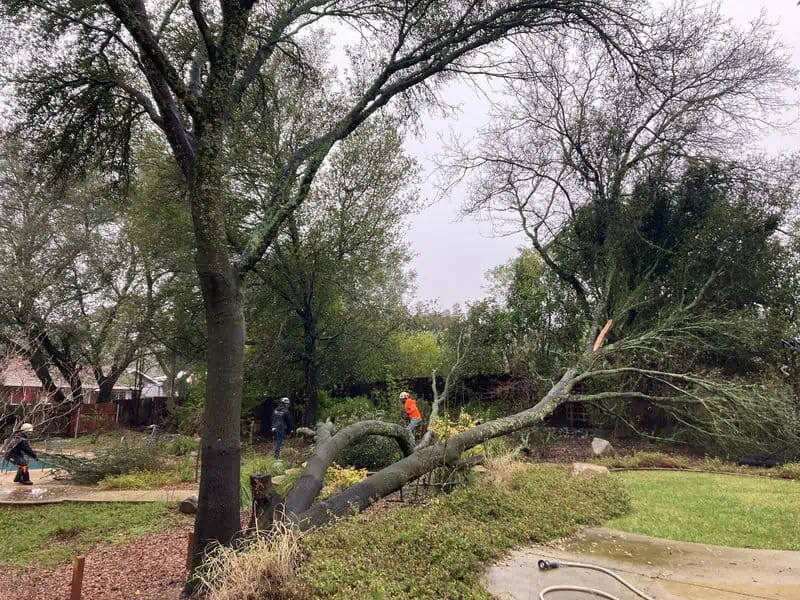
Winter storms hit Folsom harder than most people expect with rain, wind, and occasionally ice, and when they arrive trees become the biggest risk on your property.
Most of that damage? Preventable.
The key is identifying problems before the storm arrives because once wind and rain start it’s too late for prevention, at that point you’re dealing with emergency response and hoping for minimal damage.
This guide covers how to spot vulnerable trees, what preventive steps actually work, and when to call for emergency service because the best time to handle storm damage is before it happens.
Signs Your Trees Are at Risk Before Storms
Not every tree poses a storm risk but certain warning signs indicate a tree or specific branches won’t hold up when weather gets rough.
Dead or Dying Branches
Dead wood breaks easily, if a tree has dead branches in the canopy a strong wind gust will snap them off and they’ll come down wherever gravity takes them – roof, driveway, neighbor’s yard, doesn’t matter.
Look for branches without leaves (during growing season), brittle bark, or limbs that look gray instead of the healthy brown of living wood, dead branches don’t bend in wind they just break.
Cracks or Splits in the Trunk
A crack in the trunk is serious, really serious actually, it means the tree’s structural integrity is compromised and wind pressure can split the tree completely.
Vertical cracks especially deep ones indicate the tree could break apart during a storm, horizontal cracks suggest internal decay, and either way that tree needs professional assessment before storm season.
Leaning Trees
Trees don’t lean without reason, so if a tree’s leaning more than 15 degrees from vertical something’s wrong with the root system: either the roots are damaged, the soil’s eroding, or the tree’s been destabilized.
A leaning tree might stand for years or it might come down in the next storm. It’s hard to predict, but a warning sign worth noting.
Co-Dominant Stems (V-Shaped Crotches)
When a tree has two main trunks growing in a V-shape from the same point that’s a weak attachment the bark between the two trunks gets compressed and there’s no strong wood connection holding them together.
Under wind load one of those trunks can split off and you’ll often see this in oak trees and maples, if the V-crotch is low on the tree and close to structures it’s a hazard.
Root Problems
You can’t always see root damage but certain signs give it away: mushrooms growing at the base of the tree usually means root rot, exposed roots on one side could be soil erosion, cracked or lifted soil near the trunk points to the roots moving.
Roots anchor the tree and if they’re compromised the tree’s coming down eventually, storm winds just speed up the timeline.
Overhanging Branches Near Structures
Even healthy branches become problems when they’re hanging directly over roofs, cars, or power lines, a strong wind can break a branch that’s otherwise fine especially if it’s heavy with foliage or water-soaked.
If a branch is within 10 feet of your roof it’s worth evaluating, better to remove it on your schedule than have it removed by gravity during a storm!
Pre-Storm Inspection Checklist for Homeowners
Before winter storms arrive walk your property and check these items, it takes 20 minutes and could save thousands in damage.
Check the Canopy
Look up into the tree canopy and ask yourself: any dead branches visible? Crossing branches rubbing against each other? Branches growing at odd angles? All of those are potential failures during wind.
Inspect the Trunk
Walk around the base of each tree and look at the trunk: do you see any cracks, splits, holes, or soft spots? Mushrooms or fungus growing on the bark? Peeling bark in large sections?
Examine the Root Zone
Look at the ground around the tree: is the soil cracked or lifted? Are roots exposed where they shouldn’t be? Is the tree leaning more than it used to?
Identify Hazard Zones
Stand under the tree and look up, if any part of this tree failed right now what would it hit? Your house? Car? Neighbor’s property? Power lines? That’s your hazard zone.
Check After Every Major Storm
After a storm passes do a quick visual check: new cracks? Leaning that wasn’t there before? Broken branches stuck in the canopy waiting to fall? Don’t assume everything’s fine just because the tree’s still standing.
If anything looks questionable call a certified arborist for an assessment, most companies offer free inspections and catching a problem early is way cheaper than dealing with emergency damage.
Which Trees Are Most Vulnerable in Folsom's Climate
Some tree species handle storms better than others, here’s what tends to struggle in Folsom during winter weather.
Eucalyptus
Eucalyptus trees are notorious for dropping branches without warning, they have brittle wood and even healthy-looking limbs can snap off during wind, if you’ve got eucalyptus near structures keep them heavily pruned and inspected regularly.
Bradford Pear
Beautiful trees but terrible storm performance, Bradford pears have weak branch attachments and tend to split apart under wind load or ice, if you’ve got one plan for it to fail eventually (sorry to say it).
Mulberry
Mulberries grow fast which means softer wood, they’re prone to breakage during storms especially if they haven’t been pruned regularly, the branches get heavy and the wood can’t support the weight under stress.
Older Oak Trees
Oaks are generally strong but older oaks especially ones with decay or dead branches become hazards, a 100-year-old oak with internal rot can drop massive limbs without warning so inspect older oaks carefully before storm season.
Pines with Dense Canopies
Pine trees catch wind like sails and if a pine hasn’t been thinned properly the dense canopy creates massive wind resistance, that can uproot the tree or snap the trunk but proper thinning makes a huge difference.
Trees Near Structures
Any tree near a house, garage, or power line becomes higher risk regardless of species, proximity matters more than tree type when calculating potential damage.
Emergency vs Preventive Tree Removal
There’s a big difference between preventive removal and emergency removal and cost, safety, and stress levels all change once a storm hits.
Preventive Removal
This is when a hazardous tree gets removed before it causes damage: scheduled work, controlled conditions, the crew has time to plan the job, use proper equipment, and do it safely.
Preventive removal costs less because there’s no emergency premium, the tree company can schedule efficiently and there’s no property damage to work around, plus homeowners insurance doesn’t get involved because nothing’s been damaged yet.
If an arborist identifies a tree as hazardous removing it before storm season is almost always the smart financial move.
Emergency Removal
This is after the tree or part of it has already fallen: maybe it’s on the roof, maybe it’s blocking the driveway, maybe it’s tangled in power lines.
Emergency removal costs more, sometimes a lot more, crews are working in dangerous conditions often in bad weather dealing with unpredictable situations and that risk gets priced into the service.
Also emergency removal often involves property damage that needs repair after the tree’s cleared so you’re paying for tree removal plus roof repair, fence replacement, or whatever else got destroyed.
Bottom line: preventive work is cheaper.
What to Do Immediately After Storm Damage
If a storm damages a tree on your property here’s what to do right away.
Don't Touch Downed Power Lines
If a tree’s touching power lines or you even think it might be stay away and call the utility company immediately, assume any downed line is live and don’t approach it.
Assess Safety First
Is the tree blocking an exit? Creating an immediate danger? Likely to fall further and cause more damage? If yes get everyone away from the area and call emergency tree service.
Document Everything
Take photos and videos of all damage from multiple angles, document the tree, the property damage, and the overall scene because your insurance company will need this.
Call Your Insurance Company
Report the damage as soon as possible and ask what your policy covers and whether emergency tree removal is included, some policies cover removal only if the tree damaged a structure while others cover hazard removal even without property damage.
Call a Licensed Tree Service
For emergency removal call a licensed insured tree service, don’t hire some guy with a chainsaw who knocks on your door after the storm because that’s how people get scammed or injured.
Avoid DIY on Large Trees
Cutting a fallen tree seems straightforward until you realize the limbs are under tension and can snap violently when cut, people get killed doing DIY storm cleanup so if the tree’s bigger than you can safely handle with a handsaw call professionals.
How to File Insurance Claims for Tree Damage
Navigating insurance after storm damage can be frustrating, here’s how to make it smoother.
Understand Your Coverage
Most homeowners policies cover tree damage to structures like house, garage, fence but many don’t cover tree removal unless the tree actually hit something, read your policy or call your agent to confirm coverage.
Document Before Cleanup
Don’t clean anything up until after you’ve documented it thoroughly because insurance adjusters need to see the damage, if you remove evidence before they assess you might lose coverage.
Get Written Estimates
When tree service companies assess the damage get written estimates, insurance companies want documentation of costs before approving claims.
Separate Tree Removal from Property Repair
Your claim might involve two separate contractors one for tree removal one for property repair like roof or fence, keep those costs separated in your documentation.
Ask About Depreciation
Some policies pay actual cash value which is depreciated while others pay replacement cost, know which applies to your claim before agreeing to repairs.
Keep All Receipts
Save every receipt related to storm damage including tree removal, temporary repairs, tarps, cleanup – everything because you’ll need it for your claim and potentially for taxes.
How to File InsurancPreventive Steps That Actually Worke Claims for Tree Damage
If you want to minimize storm damage risk here’s what actually makes a difference.
Schedule Annual Inspections
Have a certified arborist inspect your trees every year ideally before storm season, they’ll catch problems early when they’re cheaper and easier to fix.
Remove Dead Wood
Dead branches will come down eventually so remove them on your schedule instead of letting the wind decide when and where they fall.
Thin Dense Canopies
Proper canopy thinning reduces wind resistance and allows wind to pass through the tree instead of pushing against it like a sail, makes a huge difference in storm performance.
Cable and Brace Weak Attachments
For valuable trees with weak crotches or co-dominant stems cabling and bracing can provide extra support, it’s not a permanent fix but it buys time and reduces failure risk.
Maintain Proper Tree Health
Healthy trees handle stress better and proper watering, mulching, and fertilization keep root systems strong and wood resilient, stressed trees fail faster.
Create Clearance Around Structures
Keep branches at least 10 feet away from roofs, power lines, and other structures because even healthy branches can break and distance reduces damage potential.
Remove Hazardous Trees
If an arborist identifies a tree as hazardous don’t wait, the longer a hazardous tree stands the higher the risk of expensive damage.
When to Call for Emergency Service
Some situations require immediate professional response, here’s when to call right away.
Tree or Branch on the Roof
Even if damage looks minor get professionals out to assess and remove it properly because DIY removal can cause more damage.
Tree Blocking Driveway or Street
If you can’t get in or out of your property that’s an emergency and tree services prioritize blocked access.
Leaning Tree Threatening Structures
A tree that’s leaning worse after a storm and looks unstable needs immediate attention, it could come down completely with the next wind gust.
Hanging Branches (Widow Makers)
Broken branches stuck in the canopy are incredibly dangerous, they can fall without warning so don’t walk under them and call professionals.
Any Involvement with Power Lines
Trees touching or near power lines require utility company coordination so don’t attempt removal yourself.
Schedule a Pre-Storm Assessment
The best storm prep happens before clouds even form and a professional assessment identifies problems while there’s still time to fix them safely and affordably.
Ace Tree Service provides free storm risk assessments for properties in Folsom, Roseville, El Dorado Hills, Granite Bay, and Sacramento County, ISA certified arborists evaluate trees, identify hazards, and recommend preventive solutions.
Emergency service is available 24/7 when storms hit but the goal is avoiding emergencies in the first place.
Call (916) 934-3204 for a free assessment or request an estimate online.
Storm season’s coming so get ahead of it.